
10 Signs Your Employee Transportation System
Needs an Upgrade
Every HR manager has heard it at least once—“The cab was late again.” Maybe it was brushed off. Maybe it was logged and forgotten. But somewhere between the missed pickups and the Monday morning complaints, a pattern is forming that costs more than your plan for the month.
Employee transportation in Coimbatore has improved more than just reaching from point A to B, it is about the employee’s travel experience, the company’s ROI, and the expenses for the company. With industrial corridors expanding across Peelamedu, Ganapathy, and the TIDEL Park zones and manufacturing units running round-the-clock operations, put together the pressure on the employee transport systems is higher. Having the same old corporate transport systems that were set up 5 years ago and wondering why the productivity, punctuality, and employee satisfaction are quietly slipping off is actually a reason for a weak transport service. The solution is to need an upgrade.
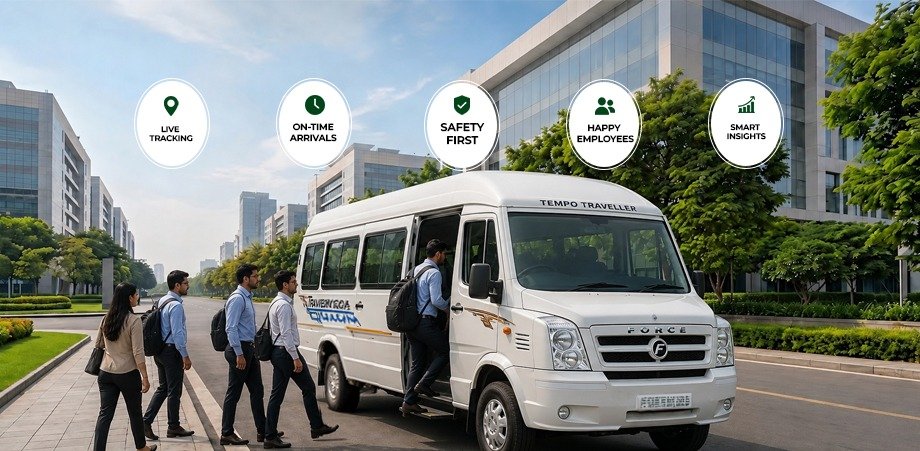
Here’s a straightforward way to tell if your current staff transportation setup is holding your workforce back.
Tardiness is the most visible symptom.
This is one of the common reasons and is concerning when the employee is using the employee commute. When employees are punctual at their doorsteps but still walking into the office late, the issue is almost always the route. Overcrowded pickup sequences, poor buffers, or a single vehicle trying to service too many opposing zones in one sweep will always cause delays. A modern employee transport service in Coimbatore plans routes around shift clusters and geographic density, not just driver convenience.
1. Employees Are Consistently Arriving Late—Even When They Leave on Time
2. Your Transport Vendor Can’t Tell You Where the Cab Is Right Now
This one’s simple. If you call your transport coordinator and the answer is “I will check and get back to you”—that’s a problem.
Real-time GPS tracking is not a premium luxury; it is a baseline expectation for a reliable corporate cab service. Knowing exactly where every vehicle is at every point of the route matters for safety, shift planning, and vendor accountability.
3. Night Shift Employees Are Making Their Own Arrangements
When employees quietly start carpooling, booking personal ride shares, or asking friends and others to drop them off after late-night shifts, your system is failing them. It means your official transport system isn’t reliable enough to count on after dark. This is a serious gap, not just operationally but in terms of employee safety, particularly for women employees navigating late-hour drop-offs.
The safety standard: True, safe employee transportation in Coimbatore means verified drivers, digital trip validation, and a strict doorstep-drop protocol that leaves no room for guesswork.
Efficiency gaps don’t always look like shortages; sometimes they look like excess. If your fleet has vehicles running half-empty on most days, or if routes haven’t been reviewed in over a year, you are likely paying for capacity you are not using. A properly managed staff transportation system uses route optimization to consolidate pickups intelligently, reducing the number of vehicles needed without compromising coverage. Overspending on transport is just as much a sign of a broken system as underspending.
4. You Are Running More Vehicles Than You Actually Need
5. Employee Complaints About Transport Are a Monthly Conversation.
Every HR team has that one transport issue that keeps coming back. Different month, same complaint. When the same person showed up in exit interviews, team feedback, and Monday morning conversations, it stopped being a coincidence a long time ago. Common recurring issues in employee shuttle service include long waiting times, uncomfortable vehicles, drivers taking unfamiliar routes, and last-minute cancellations. Any one of these once in a while is understandable. All of them on rotation means the foundation needs reworking, not just patching.
If you can’t analyse it, you can’t manage it.
Most legacy transport setups in Coimbatore operate entirely on manual coordination—phone calls, paper trip sheets, and unorganized WhatsApp groups. There is no record of on-time performance, no report on route efficiency, and no way to identify which bottlenecks (like the Hope College junction or Gandhipuram flyover traffic) are consistently causing delays. Modern corporate transportation solutions provide reporting—on-time arrivals, vehicle utilization, route performance—so decisions are made with information, not instinct.
6. You Have No Information on How Your Transport System Is Actually Performing
Think about the last time a new employee needed to be added to the team, and they requested office transportation. If it took more than a day and involved multiple people and left the new employee confused about pickup time all week, your system isn’t built for scale. A structured employee transportation setup should absorb new additions without disrupting existing routes. If one new person throws off the entire schedule, the system is already behind your growth.
7. Onboarding New Employees into the Transport System is a Nightmare
A textile unit running three shifts. A BPO with staggered login times. A manufacturing plant with overlapping handovers.
These are everyday realities in Coimbatore’s industrial landscape—and they demand transport systems that are built around shift logic, not a standard 9 to 6 mindset. If your current employee cab service treats every shift the same or can’t adjust pickups when shift timings change, employees on non-standard hours are always going to be underserved. Transport that doesn’t adapt to operations isn’t really supporting the business.
8. Your Transport Setup Doesn’t Account for Shift Changes
This is the one that should move things from a conversation to a decision
Vehicle maintenance lapses, drivers unfamiliar with routes, inadequate safety checks, and missing emergency contacts—these aren’t acceptable trade-offs in any employee transport service. Safe employee transportation in Coimbatore means verified drivers, properly maintained fleets, SOS options for employees, and defined escalation protocols. If there have been safety incidents—even minor ones—and the response was to manage the situation rather than fix the system, the risk is still there.
9. Safety Incidents or Near Misses Have Occurred More Than Once
This last sign is quieter, but it’s the one that shows up in retention numbers.
When commute stress becomes part of the job, people start factoring it into whether they want to stay. Studies consistently show that a difficult or unreliable daily commute contributes to burnout, increased leave, and eventually attrition. In a competitive hiring market like Coimbatore—where skilled workers in manufacturing, IT, and BPO have options—the quality of the commute is part of the employee experience whether companies acknowledge it or not. If your people are exhausted before they walk in, the transportation system is already working against you.
10. Your Employees Dread the Commute Instead of Just Doing It
What a Better System Actually Looks Like
If three or more of these signs feel familiar, your transport system isn’t failing dramatically—it’s failing quietly. And quiet failures have a way of showing up loudly in absenteeism, attrition, and morale. Park Travel has been solving exactly these problems for Coimbatore businesses—with structured routes, real-time tracking, and transport that your employees can actually count on.
Ready to fix the commute for good? Reach out to Park Travel today and let’s build a system your employees can count on.
A commute that works isn’t a perk. It’s just good operations.
“Because the cab that shows up on time says more about your company than you think.”