
From WhatsApp Coordination to Real-Time Tracking-
The Evolution of Corporate Transport in Coimbatore
It’s 7:45 AM. Three employees are standing outside their apartments in Singanallur, staring at their phones. The cab was supposed to arrive at 7:30. The group chat has gone quiet. The transport coordinator isn’t picking up. And the morning shift starts in fifteen minutes.
This wasn’t an unusual morning for most Coimbatore companies five years ago. It was Tuesday.
The city has always moved fast—textile mills running before sunrise, engineering firms clocking in across multiple shifts, and now a growing belt of IT parks and BPO hubs along Saravanampatti and the bypass road pushing corporate operations into round-the-clock territory. But for the longest time, the way companies managed employee transportation services hadn’t kept pace with any of it. The operation ran on phone calls, paper logs, and the quiet hope that the driver would show up.
That’s changing. And the shift has been more significant than most companies realise.
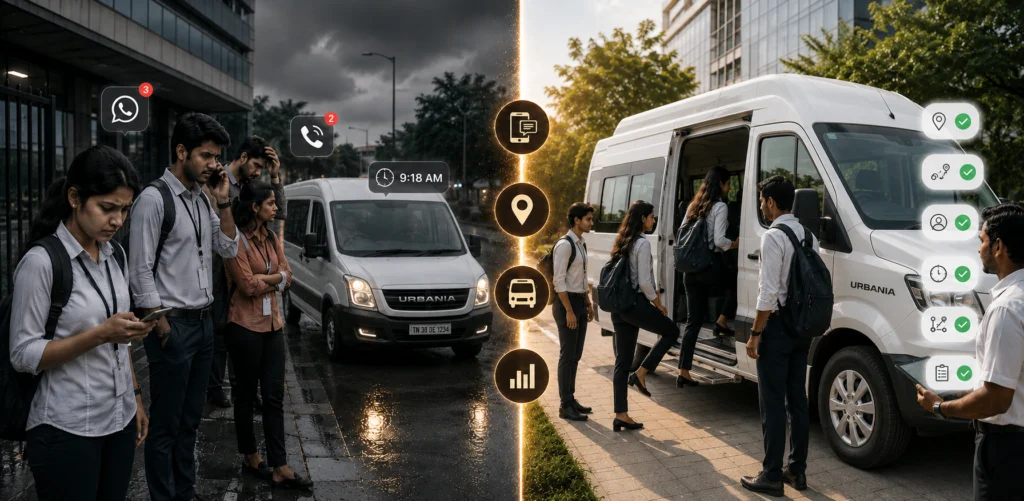
When WhatsApp Became the Logistics Department
Nobody decided this was a good idea; it just happened.
At some point in the early years of Coimbatore’s corporate, someone added the cab driver to a WhatsApp group, and that became the system. Coordinators would send morning confirmations. Drivers would respond with a thumbs up. Employees would message, the actual information—whether the cab was on route, delayed, or stuck behind the Hope College junction traffic—got completely lost.
The result was a transport setup that looked functional on the surface but was held together entirely by people working overtime to compensate for the gaps. HR teams were spending the first hour of every working day managing cab logistics instead of actual HR work, and when something went wrong—a driver calling sick, a vehicle breaking down on Trichy Road—there was no backup protocol. Just more phone calls.
The hidden bill of a WhatsApp-run transport system was bigger than most companies noticed.
The most obvious cost was time—hours spent every week on coordination that should have taken minutes. But the less visible costs sat in the routing. When routes are planned manually, they are planned once and rarely reviewed. So, a cab that made sense six months ago, when three employees lived near Gandhipuram, was still running the same loop after two of them moved. Vehicles ran half-empty. Fuel bills didn’t reflect actual headcount. And nobody had the data to notice because there was no data — just a driver’s logbook that nobody audited.
For companies that needed office transport cabs across multiple shifts, the strain was even more obvious. Night-shift employees making their own arrangements. Morning batch pickups bleeding into each other. And for any travel outside the city—a regional sales visit to Tiruppur or a client meeting in Salem—someone had to call around for an outstation cab service and negotiate a rate on the spot, with no record of what was agreed or who confirmed it.
What Manual Coordination Actually Cost
The First Real Shift – GPS and Basic Accountability
It started simply – one screen that showed where the vehicles actually were.
The first change most Coimbatore companies made wasn’t a full technology overhaul. It was just GPS. A live map showing vehicle locations, available to the transport coordinator and HR team in real time. That one addition changed the morning entirely. Instead of calling the driver to ask where he was, the coordinator could see it. Instead of telling an employee, “He’s on the way,” there was an actual ETA.
It sounds basic. But for companies managing eight to fifteen office transport cabs across different zones—Peelamedu, RS Puram, and Vadavalli—that single layer of visibility cut the average response time on delays from 20 minutes to under five. Employees stopped calling the coordinator. The coordinator stopped calling the driver every ten minutes. The morning actually ran.
Route Optimisation—When the System Started Thinking
The bigger change wasn’t tracking where vehicles were. It was planning where they should go.
Manual route planning has one consistent problem: it’s built on memory, not data. A coordinator who has been managing the same routes for two years knows which areas have heavy pickups and which stretches of road slow things down near the Avinashi Road signal during peak hours. But that knowledge lives in one person’s head and doesn’t scale when the company adds fifty new employees across three new residential zones.
Automated route planning changed that. By mapping employee locations against shift timings and vehicle capacity, companies could consolidate pickups intelligently, reducing the number of vehicles needed without leaving anyone waiting longer than necessary. Economy cabs in Coimbatore that once ran at sixty percent capacity started running full. The cost per employee dropped. And the routes actually made sense geographically instead of just following the order in which people had joined the company.
The commute was only half the problem. Business travel was its own separate headache.
For a long time, daily employee transport and business travel lived in completely different worlds within the same company. The transport coordinator handled the morning and evening runs. Someone in admin handled outstation bookings. And when a senior manager needed intercity cabs in Coimbatore for a client visit to Erode or Bangalore, they were going through a different vendor, a different process, and a different billing system entirely. For many companies, intercity cabs in Coimbatore were being booked reactively—last minute, over the phone, with no record of what was agreed.
Bringing both under one transport partner changed the operational picture significantly. The same vendor managing daily employee transportation services could also handle the outstation cab service for a regional sales trip, with the same driver standards, the same billing transparency, and the same accountability. Employees travelling for work could book a taxi through the same system the company already used—no new approvals, no separate invoices, and no rate negotiations happening over WhatsApp at 9 PM.
Intercity And Business Travel – Bringing It Under One Roof
Where Coimbatore's Corporate Transport Stands Today
The companies that moved early on this are running leaner operations than those that didn’t.
The shift from manual coordination to structured, tech-backed employee transportation services didn’t happen overnight, and it hasn’t happened evenly across the city. There are still companies managing their entire transport operation through group chats and spreadsheets, paying for the inefficiency every month without connecting it back to the system. And there are companies that made the switch two or three years ago and have since cut their transport overhead, improved punctuality, and stopped losing the first hour of every workday to logistics.
The gap between those two groups is growing. Companies that invested early in the best cabs in Coimbatore—with structured routes, verified drivers, and real-time tracking—are now running leaner operations and retaining employees that others are losing to commute fatigue.
A cab that shows up on time, to the right address, at the right hour—that’s not a small thing. Ask anyone who spent six months waiting on a WhatsApp confirmation that never came.
Good transport doesn’t happen by accident—it happens because someone built the right system around it.
Park Travel has been managing corporate transport for Coimbatore businesses for over 14 years, recognized consistently as one of the best cabs in Coimbatore for corporate and employee transport. From daily employee runs across the city’s industrial zones to outstation cab services for regional business travel, every route is planned with shift timing, vehicle capacity, and employee locations in mind—not just what’s easy for the driver.
If your company is still running transport on phone calls and group chats, it’s worth looking at what a structured system actually looks like. Whether it’s a daily employee run or a last-minute regional trip, your team can book a taxi without chasing approvals or negotiating rates over WhatsApp. New joiners, visiting executives, or last-minute client runs—anyone in the company can book a taxi in minutes through one central system.